
A Dinner Club Your Audience Fills for You
Rae Lambert built DNNR so creators can sell dinners without planning one. A podcaster with 4,500 Instagram followers and no email list filled seven tables on his first try.
 TJ LarkinHost, Local Media HQ PodcastSeptember 30, 2025 · 8 min read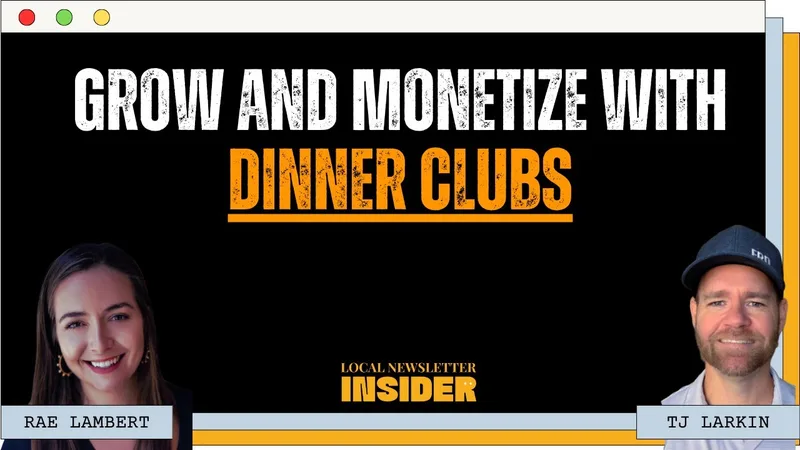
- The creator does not run the dinner. Guests take a quiz, get matched into tables of six, and the restaurant is a surprise until that morning. DNNR handles the bookings and the messages.
- Rae tells creators not to show up. If you are the draw, the whole table talks about you instead of meeting each other.
- A small audience was enough. Troy Farkas had 4,500 Instagram followers and no email list, and filled seven tables (42 people) at his first dinner.
- It is a business with no upfront cost. Seats are usually $16 and food is extra. DNNR keeps 30% of ticket revenue and charges no subscription.
Everybody wants more in-person connection, and nobody wants to plan the event. Rae Lambert's answer is DNNR (say "dinner"), a platform that turns an audience into a dinner club without the creator doing the work. We talked about how it works, what happened when a small-town podcaster tried it, and what it means for local newsletters.
A dinner club with no host
Rae says plenty of people run their own dinner clubs, usually 12 to 15 people with the host as the anchor. The catch is the work. A table that size can't be booked online, so you call the restaurant back and forth, and splitting the check is a hassle.
DNNR does it differently. The creator announces the dinner, guests fill out a short personality quiz, and an AI matching tool puts them in groups of six. DNNR books the restaurants and sends every message. Guests find out where they are eating the morning of, and who else is at the table stays a secret until they sit down.
Then comes the part that makes it feel like an event. During dinner everyone gets a text that the night is not over, and every table heads to the same cocktail bar to meet even more people.
Why she tells creators to stay home
Rae's advice is blunt: we implore you not to go to the dinner. If you are any kind of a celebrity, she says, the conversation at the table will revolve around you. Those six people came to meet each other, and your audience may want to hang out with each other more than with you.
She also pushed back on a talent agent who kept saying creators could just run a pop-up dinner themselves. Her answer was that this isn't about the creator at all.
It's more of like your audience could be a network, like a community where they interact with each other. They're not just interested in you.
Seacoast Stories filled seven tables
DNNR's first customer was Troy Farkas, who makes Seacoast Stories, a local podcast about Portsmouth, New Hampshire, and the towns around it. Rae says Portsmouth has about 22,000 people. Troy talks to business owners and the mayor, and he had 4,500 Instagram followers and no newsletter or email list.
At his first dinner, he filled seven tables. That is 42 people. He called his visits to each table "table touches," Rae filmed him saying hello to every table, and everyone ended up at a bar downtown.
Rae shared a few details that stuck with us:
- A surprise match. One table was set up by budget, and five of its six guests turned out to go to the same high-end gym. They had never met.
- Strangers join in. About 15 to 20% of people who come to the dinners don't know who Troy is. A friend just told them to come.
- Followers went up. Troy had gone from 4,500 to 7,000 Instagram followers in two or three months.
Troy has now done three dinners and is about to do his fourth. He posts about it once a month, and Rae says people tell their friends and come back, which she calls a pretty juicy flywheel.
Keep it one dinner club and let the quiz do the sorting
I asked whether we should run separate dinners for moms, dads and business owners. Rae said no. One bigger dinner club with a good quiz works better, because you can ask whether someone is a parent or a business owner and the matching tool will seat like with like. You can still promote cohorts inside it.
In Greenville, South Carolina, one club puts parents together and child-free people separately because Rae says they are more likely to get along with their own kind. Rae told us Greenville sends about 25 tables to dinner. She also wants at least three tables per dinner, so the groups can meet at the bar afterward. With only four people here and nine there, she says, it gets weird.
How the money works
The creator gets a landing page that looks like their brand, with their logo, colors and a name like seacoaststories.dnnr.io. A guest clicks to book a seat and takes the quiz. Each community writes its own questions and weights them, so "parent" can count for a lot in one club and values matter more in another.
Seats usually cost $16, and the creator sets the price. Rae said it could go lower, or even hit $500 for a charity fundraiser dinner. Food and drink aren't included. The ticket pays for the reservation and the matching, and guests split the tab or ask for separate checks.
For creators there is no upfront cost. DNNR keeps 30% of ticket revenue, so as Rae puts it, if you make money, they make money. Rae says it's the biggest easy money Troy has made, because his audience is too small for a $1,000 Instagram sponsorship.
- 01Announce it
The creator emails, posts or mentions it on a podcast
- 02Take the quiz
Guests answer questions the creator customized
- 03Pay for a seat
Usually $16, food and drink not included
- 04Get the reveal
The morning of, guests get an email and text with the restaurant
- 05Meet at the bar
During dinner everyone is texted to head to the same bar
Why this fits local media
I asked Rae whether people will keep caring about local as AI content takes over. She said yes, and pointed to Google searches for making friends near me and for loneliness trending up. She thinks local newspapers had a dry spell because the business model broke, not the demand. People still want local stories and community.
We also talked about a geography advantage. If you have 10,000 subscribers in LA, Rae said, you have more followers there than the All-In podcast does. A global brand with 5 million followers has fans scattered around the world. Troy's 7,000 followers are all in one place, which she says makes the number bigger than it feels.
Lead with value when you build a community
We spent a stretch on groups for local business owners. Rae lives in a small New Hampshire town and says the chamber of commerce mostly serves brick and mortar shops, restaurants and retail. Plenty of business owners have no place to go.
She also described going to a local tech meetup where someone asked her to pay $500 to join before anyone asked what she was building. Her advice was to lead with value. She also warned to watch who makes up your group: if most of the people paying are there to sell something, the community will drift.
How to start
Right now you book a demo with Rae on dnnr.io, because DNNR is on the hook for the matching and the reservations and doesn't let people create their own communities yet. She said self-serve setup is coming. Setup is usually one 30-minute call. She'll brand it for you and help with the questions, then you tell your audience by email, a tweet, Instagram or your podcast. She expects the first dinner to need a bit more coaxing, since people aren't used to the idea.
Rae said she soft launched DNNR with a story about Troy rather than a pitch, and her week filled with sales calls. About 15 new dinner clubs were launching around the country, and she added that she had a Meetup platform before DNNR that wasn't taking off. She bought the dnnr.io domain for about $40 as an experiment.
Questions people ask
What is DNNR?
How much does it cost?
Do I need a big audience?
How do I get started?
TJ is the founder of Local Media HQ. Every week he talks with local media operators about what is actually working in their towns.