
Pick Up the Phone and Sell Ads, Says the Arlington Bagel
Billy Howell grew Arlington Bagel to 3,500 subscribers in six months with Facebook ads. His advice: call the businesses your readers click on, and sell to advertisers with a high customer lifetime value.
 TJ LarkinHost, Local Media HQ PodcastMarch 13, 2025 · 9 min read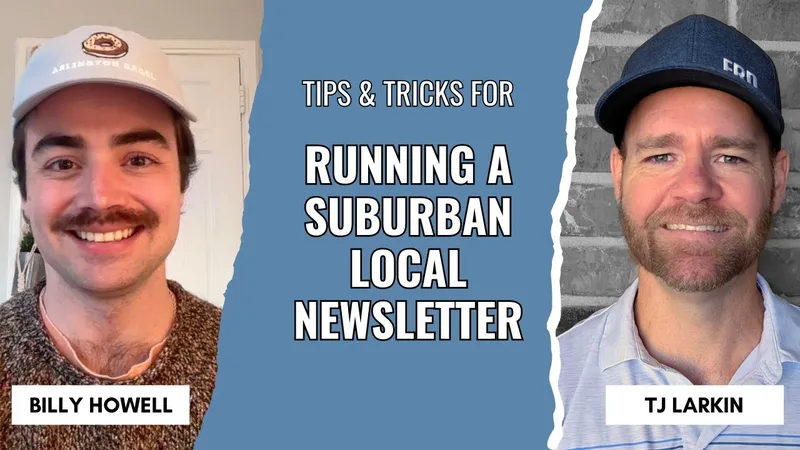
- Pick up the phone and sell ads. Billy burned hours on scraped email lists and automated templates. What worked was calling businesses whose links got the most clicks. He landed one yes on four calls.
- Sell to advertisers who can wait. His main sponsor is a med spa, because one new customer pays back the ad. One $50 restaurant meal doesn't.
- Buy growth on Facebook Stories and Reels. Billy runs $20 to $40 a day, targets a 10-mile radius around Arlington, and says Stories and Reels are the cheapest placements.
- Test your send time. Everyone told him to send early. Billy gets better results at 10 a.m. than 7 a.m., and some of his best open rates came from 7 p.m. sends.
Billy Howell runs the Arlington Bagel, a weekly events and restaurant newsletter for Arlington, Virginia. We recorded his send number 26, about half a year in, with roughly 3,500 subscribers. He also runs a marketing agency, so he treats the newsletter as a platform, not just a list. In this conversation he covers the send-time surprise, how he buys subscribers, why he skips news, and the advice he'd give himself: pick up the phone and sell ads.
A silly name and a 10 a.m. send
Billy wanted a name people would remember. He looked at newsletters like Morning Brew, where the name ties to the morning and breakfast, and thought about breakfast foods. When he said "Arlington Bagel" out loud it sounded so silly that he figured people would remember it. They do, and he says people really like the name.
He originally sent at 7 a.m., so people would see it when they woke up and grabbed their phones. Then he noticed he does better at 10 a.m., when people are at their desks. That runs against what a lot of people are saying, and he says so himself: with 3,500 subscribers it may be a small sample.
His issue goes out on Thursdays, so people can plan the weekend. In the days when his process was messier and he sent late, he sometimes got his best open rates from a 7 p.m. send. TJ's take: an extra late-night send could be worth testing.
Events and restaurants, no news
Billy covers events and restaurants only. He started with news and stopped because he saw no need for it. Arlington is small and sits next to DC, so people don't realize how much is going on locally. Restaurants in the area also turn over constantly, and he says people there don't really have a favorite place, so they want help deciding where to go.
There was a business reason too. Restaurants and event partners can pay for ads and sponsorships. A story about new traffic cameras, he says, mostly means "carrying water for the local government." It doesn't help his monetization.
Facebook ads: Stories, Reels and a 10-mile circle
Billy buys almost all of his growth on Facebook. He started with an ad modeled on the Naptown Scoop one, with an AI woman looking at her phone and the line about always knowing what's going on in Arlington. It did great, and he says video now beats still images.
Placements matter. He began with feed placements and stopped, because the feed skews to an older audience. Now he runs Stories and Reels almost exclusively, which he says are the cheapest way to get clicks and subscribers. He pauses the ads when costs spike, as he did over the holidays.
He targets a 10-mile radius around Arlington and excludes Washington DC and Maryland, because both fall within 10 miles of his city. He started testing at $10 to $15 a day, split across several creatives. He now spends about $20 to $40 a day and uses dynamic ads that mix images and videos. He admits people argue about whether to test creatives one by one, and says you should try both.
His readers skew about 65 percent female, mostly late 20s to early 40s. The ads also grow his Instagram, which sat around 1,500 followers next to 3,500 subscribers.
A med spa beats a restaurant
Billy's main sponsor is a med spa, and its ad sits at the top of the main send. His readers skew young and female, which is the med spa's target customer. The sponsor offers readers deals, such as a first skin peel.
His rule: look for advertisers with a high lifetime value that can be patient. One referral and they make their money back. He doesn't want to say "don't partner with restaurants," but for a single restaurant, one $50 meal is hard to justify. TJ added that a regional restaurant with locations in several of his cities could be a better fit.
Billy also has a volunteer sales rep, Anua, who reached out because she was a fan of the newsletter. She handles inbound and outbound sponsorship leads, follows up and mocks up ads. He is about to sign a second sponsor, and tested ads for a friend's real estate listings.
Pick up the phone and sell ads
When TJ asked what he wished he'd known six months earlier, Billy didn't hesitate: pick up the phone and sell ads. He had burned hours on automated email templates and a scrape of every restaurant in the Arlington area. It just didn't work as well as talking to a person.
- 01Read the clicks
He looked at the past four sends to see which links got the most clicks, and which businesses they belonged to.
- 02Call the business
He said he'd looked at the February numbers, that theirs was the most clicked link by far, and asked to send a mockup of an ad.
- 03Expect small odds
He went one for four. Only one person picked up, and that was a yes. The other three went to voicemail, and one might buy in six months when there's budget.
- 04Keep reporting simple
He tracks results in Excel and tells advertisers how many people saw the ad and clicked. Business owners don't want dashboards.
After a sale he spends time on the creative, so he knows the copy will work for his audience. He says it works because he's written for 26 weeks in a row. He thinks that real numbers, like "30 people clicked on your business," beat made-up impression claims.
Same format every week, plus reader pets
Billy keeps the format identical each week. Restaurant news is an emoji, a headline and bold text. Events are an emoji, the place, and the event name linked to tickets. That consistency means he can teach a virtual assistant or AI to do the formatting, which is how he built a Slack tool that sorts an event or news story and sends it back in his format.
He also asks readers to send in pictures of their pets and puts one at the top of each issue, with a "Happy Thursday" line. People are obsessed with getting their pets in. Friends ask why he hasn't run their cat yet, and his mom, who doesn't live in Arlington, sends her dog's picture every week. TJ pointed out that a pet section could attract a pet-business sponsor.
His referral program is simple: two referrals get a birthday shout-out, and eight get an Arlington Bagel hat.
People want you to make decisions for them. That's what people pay for in consulting. But I think even with these newsletters, like the events, people want you to help them figure out what to do each weekend.
Three more towns, one remote writer
Billy plans to launch two or three more publications: his hometown, his college town and his fiancee's hometown. They are all similar to where he lives. He says the extra work is small. He has a writer, a guy from Chile living in Portugal, who already does a lot of his marketing work. Billy sends a list of sources, the writer pulls news items, and Billy says yes or no and edits them into his voice.
Everything runs in Beehiiv. He already pays for a big growth plan because of his agency clients, so the main new cost is ads. He'd start those at a couple of dollars a day. He also mentioned City Spark, a platform that pulls in events and lets businesses buy event ad slots.
AI as a starting point, and one post he regrets
Billy thinks AI is good for people who are already good at what they do. Most people stop at the AI summary, he says, and skip "the last 10 percent" of personalization. He uses it as a building block to gather and summarize news, then chisels it into his own voice. His line on trust: people don't want to feel tricked, so AI for reporting is fine, but using it to give opinions or add color is tricking them.
He also shared the most devastating feedback he's gotten. He wrote a tongue-in-cheek description of a dive bar's comedy event, and a reader wrote back that it sounded like he didn't know Arlington. It was the only time he's written in that tone. His advice is that if you're tempted to say something that isn't "rainbows" about a business, don't write it, because it's people's livelihoods.
His closing advice: get your core competency down, deliver the same thing every week, and stop messing around with side quests. One hat and one shirt is enough, he says, and you don't need a whole clothing line. Focus on Facebook ads for growth, write decent content, and call people.
Questions people ask
How did Arlington Bagel get its name?
What send time works best for a local newsletter?
Should I sell ads to restaurants?
What should a new local newsletter focus on first?
TJ is the founder of Local Media HQ. Every week he talks with local media operators about what is actually working in their towns.