
A Local Media Company Is Calling About Shane's Newsletters
Shane Brady runs local newsletters with 32,000 subscribers. A long-established company wants to talk about buying one, and he explains why selling the ads is harder than growing the list.
 TJ LarkinHost, Local Media HQ PodcastFebruary 6, 2026 · 11 min read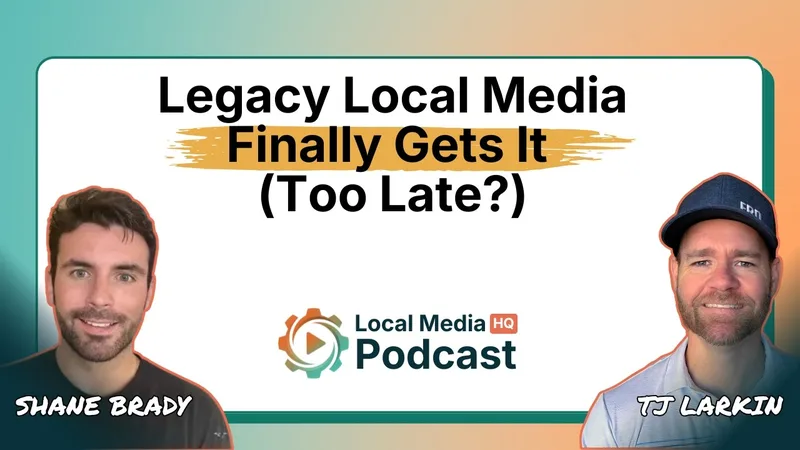
- A local company wants to buy. Shane can't say who, but a business that has been around a long time, in his area, follows him online and is in talks with him. TJ is getting similar calls.
- Growing the list is the easy part. Shane says Meta ads get you subscribers. Selling ads is the hard part, and the older companies figured that out first.
- Time decides everything. Capping his curation and setting a weekly schedule cut his issue work from 3 to 4 hours to under 20 minutes. A local writer now does nine issues a week in 3 to 4 hours.
- Ad sales start free and stay plain. Shane gave away his first ads, swapped with the biggest business in town, then priced in plain English: this many people will see it on Monday, and it costs $300.
TJ Larkin first talked with Shane Brady on the show around May 2025. A lot has changed since, and the two of them are now partners on newsletter software. In this conversation Shane explains what happened when a company that has been around for a long time called about buying his newsletters, and what that says about where local media is headed. Then he gets practical: how he cut the work of each issue, why his writer lives in his country, and exactly how he sold his first ads.
A company that has been around forever came calling
Shane says it was not who he expected. He can't name them because they are in talks right now. He will say it's a company that has been around a long time, has eyes on the newsletter space, and is one of the bigger companies in his area.
The person Shane talked to follows him on a few social platforms and had been watching the newsletters do well. Their questions were about the day-to-day: how he operates, how big the newsletters are, what a subscriber costs to get, and how he finds advertisers. Shane says some of what the local newsletter community does with Meta ads feels like a hack, and it's just new to people who have been in local media for decades. He also says the end goal of the newsletters never really hit him until that conversation.
TJ says this lines up with what he sees. He is getting the same kind of inquiries, including from some very big players, nine-figure companies that don't fully understand what's going on but know something is. His read is that the gap will close at least somewhat, especially on Meta, where these companies are direct competition.
The easy part and the hard part
Shane's version of the playbook is simple. Set up a Meta account, find the ad set that works, put money into it, build a big subscriber base, send content. Then comes the part he calls the hardest: you have to monetize. If you can figure out Meta ads, growing the list is the simpler part.
What caught his attention is that the older local media companies have it backwards from newsletter creators. They worked out how to sell to local advertisers long ago, so they solved the hard part before the easy part.
He says the ones he's talked to are slow to use Meta ads for two reasons. The first is they see Meta as a competitor for local business advertising dollars, the company that has been taking their business for the last 10 years. TJ adds a second one: some of them feel it's morally wrong, as if journalists shouldn't have to pay to get readers.
Shane also points out he had never done media before Beehiiv and Meta ads. He had a full-time job, a new baby and not much time. If he could figure it out, he says, imagine a good journalist with original content who can send it to tens of thousands of people locally.
Going from one send a week to three
For the first month or two, Shane sent once a week. Then he did the math: he had three ads in the newsletter and sending weekly was the most he could ever make. So he sent more.
That raised a new problem: what goes in the extra issues? At first it was a list of events. He was nervous about adding news, but when he tracked the content categories, the most clicked items were always the news and community updates. So news went in.
He is honest about the cost. When he made the jump, unsubscribes went from about three per newsletter to about 10, twice in a row, when the newsletters were at roughly 1,500 to 3,000 subscribers. Then it plateaued. Some people who had unsubscribed came back, because the newsletter had quickly become a key source of news in the community.
I had to get away from my ego about what people are going to think about me and just go, is this a business or am I doing a hobby? I wanted to have a business.
Three hours of curating down to 20 minutes
Early on, one issue took Shane about three hours. He would put in 35 events, and he'd check the pub in the next city over to see if it had a good live band that week. Readers probably liked it. He was also burning out.
His fix was a time cap. It's a free newsletter, nobody is paying $5 a month for every event in the county, and it will never be perfect. So he decided how much time he could spend and built the issue around that.
- 01Pick the time first
He decided how long each issue could take, then built around it.
- 02Pick the sources
A fixed set of places to pull from, instead of searching everywhere.
- 03Cap each section
A set number of items per section, no matter how much is out there.
- 04Give each day a job
Every Monday, Wednesday and Friday. Real estate on Wednesdays, a restaurant on Foodie Friday.
- 05Replace the scramble
He went from duct-taping 15 tools and websites together to an assembly line.
That took the work from 3 to 4 hours to under 20 minutes. The time he got back went into selling ads. If you are writing the newsletter and never selling, he says, you get a snowball effect where you can never monetize.
Readers notice the small stuff. Shane says a subscriber at a craft brewery told him the newsletter once let him know his trash day had changed, and that was enough value for the month.
Why his writer lives in his country
At one point Shane hired an overseas virtual assistant. He calls it the worst decision he's made in business. It took three or four tries to find one who would show up and do the work. Then there was the geography problem: one of his newsletters is in Belleville, and there are four Bellevilles in North America. The newsletter would arrive around 10 at night with news from Belleville, Illinois, which isn't even in his country. He would rewrite it himself.
So he hired a local writer in Canada who can't make that mistake and can decide quickly what goes in. Shane says he saved money in the long run. There is no back and forth now. She writes the news, it sits scheduled in Beehiiv, and he doesn't even look at it.
Here's what that looks like in numbers:
- Her workload: three newsletters, three issues a week each, so nine issues.
- Her time: about 3 to 4 hours a week, or 30 to 40 minutes an issue, including reviewing it and the ads.
- Reader feedback: the polls at the bottom of the newsletters are about 90 percent thumbs up since she took over. Shane says she's better than he was.
She does it in lightbreak. TJ's comparison is that most VAs would take about three hours for one issue, so paying more for the right person meant paying less overall.
How he sold his first ads
His town is small, rural and blue collar, with about 50,000 people. Shane says businesses there who were used to radio ads and bench ads didn't know what a newsletter was.
Here is what he did, in order:
- Free ads to people he knew. He told a few local business owners he'd throw up the ad and, if they got a lead, they could pay what they thought it was worth. If it was a $1,000 job, buy him a beer. He just wanted other businesses to see that he sold ads.
- A swap with a very large business. Once he had some interest and subscribers, he went to what he calls a pinnacle business in his city and offered a trade. Once they were in the newsletter, he says it was game over, because everyone in town knew them. He doesn't close everyone, far from it, but a warm lead rotation matters.
- Pricing in plain English. Don't say CPM or click-through rate. Say that 10,000 people will see the ad on Monday morning and it costs $300. Then ask if they want to try it.
- A better type of advertiser. For a while he let anybody advertise, including local authors selling books on Amazon. He then picked five or six industries with high customer value, since a business that gets three customers from an ad can run it for a year.
He also keeps a sponsorship portal. Businesses submit their creative and assets themselves, which ended the 9 p.m. emails asking to change a URL for tomorrow's issue.
The link at the very top
Shane puts one line above the intro of every newsletter: "Could your business use a boost?" with a link to advertise. It goes to a form, not a price list. He says about 90 percent of the time, each newsletter brings in one warm lead, even if some clicks are accidents.
TJ had been putting a similar blurb about 60 percent of the way down. After hearing this, he said he needed to message his team that day to move it to the top.
They also talked about self-serve ads. Shane has had a $400 purchase come through the portal and says it's the best feeling. He doesn't put prices at the top because he only does six-month-plus contracts, and he doesn't expect anyone to buy one straight off his website. His advice for someone starting out is to list an event for $50 in a self-serve portal and see if anyone buys it. If they do, raise it. If not, go down.
TJ's idea for bigger partners is to give them more than a placement. A one-off ad is a stock spot, but a six or 12-month deal could include social posts, articles on the website and some content they can reuse.
What Shane would do differently
Shane says his list is long, but a few things jumped out:
- Skip the overseas VA. It was his first answer, and it was a terrible decision.
- Stop worrying about what people think. He started in his hometown and worried people at the grocery store would be upset about a city hall story. He decided no one really cares that much, but he hesitated and took too long on content.
- Set up systems from day one. Without a process, the three to four hour grind nearly made him fold the newsletter.
- Build the Instagram following. He hasn't done it and thinks advertisers care how big it is. He'd hire it out.
TJ's own list starts the same way: don't stress the details. He asks what changes if you put in six pretty good events instead of the 10 best. His guess is nothing. His other time sink is the images made for each issue. Until it's automated, he says, it's probably not worth it.
lightbreak and the next show
TJ built his own newsletter software and Shane built his own. They decided they were better off together, and that's lightbreak. TJ says it now automates the images they used to spend about 10 minutes each on.
TJ ended by saying they're starting a second show and newsletter about media brands, built around the idea that the goal of a media brand is to sell something else. He says he sees the idea discussed multiple times a day and used Disney as an example, using media as marketing for its other businesses. Shane is excited to look at random niches. He mentioned media brands making millions on Pokemon trading card news, and a Twitter account that aggregates Tesla stock news. They had not recorded the first episode yet.
Questions people ask
Who wants to buy Shane's newsletters?
Why did Shane go from one send a week to three?
Why did Shane stop using an overseas VA?
How did Shane get his first advertisers?
TJ is the founder of Local Media HQ. Every week he talks with local media operators about what is actually working in their towns.