
How to Sell Newsletter Ads: Lessons From a Sponsorship Coach
Justin Moore and his wife have earned over $5 million from brand deals. He explains how to pitch local advertisers without sounding generic, and why custom proposals beat packages.
 TJ LarkinHost, Local Media HQ PodcastJanuary 7, 2026 · 9 min read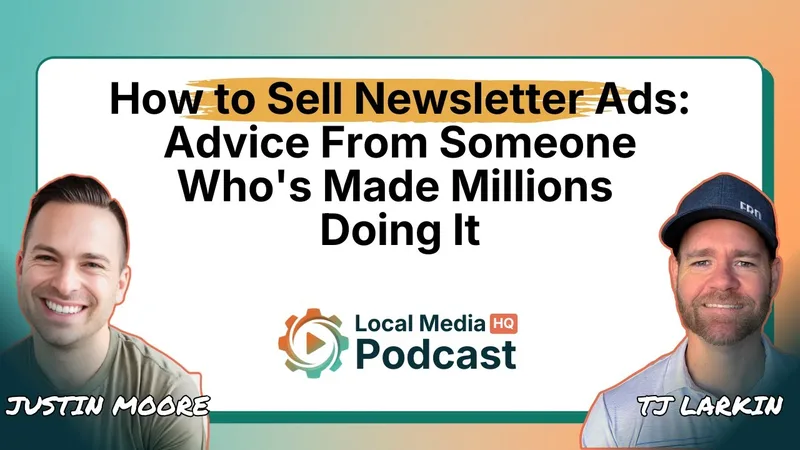
- Never tell an advertiser they are doing it wrong. Pitching "I'm better than the paper you use now" makes the decision maker look foolish. Offer something that adds to their current plan instead.
- Pitch with ROPE. Be Relevant to a campaign they ran, link one Organic post, give Proof, and make it Easy to say yes. Justin says coaching clients get about a 50% response rate this way.
- Ask what they want before you send a package. A business after awareness needs reels. One running a holiday promotion needs newsletter blasts. Boilerplate packages leave money on the table.
- Survey your readers, then pitch what they told you. Their answers to a short survey tell you which advertiser to approach and what to say.
Justin Moore says he and his wife April have earned over $5 million working with brands. It did not start with a plan. April made YouTube videos, brands sent free products, and Justin figured she was leaving money on the table.
TJ came to this interview with a problem many local newsletter operators share: a product readers love, and far less ad revenue than the legacy papers get. Justin's answers cover how to talk to advertisers, how to pitch, and how to find the right ones to pitch.
From free hair curlers to $700 a month
April started her YouTube channel in 2009, when you could barely earn from YouTube at all. Brands soon offered her free products, like a hair curler or a makeup item. She was happy to take them. She and Justin were in their early 20s with no money.
Justin was working in medical devices and taking MBA classes at night, including advertising and negotiation. He told April a free $30 product was not fair pay for the hundreds of people commenting that they had gone out and bought what she showed them. His advice: ask the next brand if it has a budget. She was sure none would pay.
The next brand she asked offered $700 a month for two videos a month. Their next thought was how to find ten more like it. Over the following decade or more, they earned over $5 million from brands, and it was their main income for years.
Don't tell advertisers they are wrong
TJ pointed out that his newsletters are often more engaging than the legacy competition and still earn far less. Justin warned against making that comparison to an advertiser. Telling a business that spends $5,000 to $15,000 a month with the local paper that you are the better buy is, in his words, inadvertently condescending.
There is also a career risk. If that person tries you and you beat the paper by a mile, they now look bad to their boss for ignoring it for five years. Staying put is easier. TJ added that change also means learning something new and sending you information.
So Justin starts differently: you don't need to change anything about your current media strategy. Let's add something that works alongside it.
Speak their language, then sell more than ads
Justin's example: a business says it spends $5,000 a month on Facebook ads at a 2x or 3x return and asks you to guarantee the same. You can't, so that conversation goes nowhere. The better move is to look through their Facebook ad library and tell them you can make better ads than the ones they are running.
Now the deal can be $5,000 to $7,000 for video assets you make and license to them, maybe with ads in your newsletter as part of it. Many local companies have no full-time marketer and cannot keep up with trends. Producing content for them could become a multi-thousand dollar, even five-figure, revenue stream.
If you only have a newsletter, you could write a guest post for their blog four times a month or help them start their own list. Don't want to run an agency? Sell consulting. Justin's idea is a $5,000 or $10,000 playbook or a retainer of a couple thousand a month, with a local agency handling the work and paying you a finder's fee. TJ said a local business had asked him to manage its Meta ads, and this was the answer he needed.
Start with your own list, then think singles and doubles
Justin's lowest-hanging fruit: email your own list and ask who wants to sponsor. Your readers include decision makers who never knew it was an option. Do it every month or quarter, not once.
Then he told the Moneyball story: the Oakland A's won by getting on base with singles and doubles. His $5 million came the same way, from small, mid-size and large brands. Big accounts are rare for local media.
TJ prefers chasing mid-size advertisers, like a 30-person trash company, and letting small shops come in on their own. Justin agreed, with a caution: big advertisers bring red tape and more rounds of revisions.
Ad agencies are tricky because they buy per campaign. Justin's better play is a lunch and learn. He has catered lunch for agency staff for $400 or $500 and says it has led to six figures of business.
Why Cincy Scoop wins on Instagram
TJ noted that newsletter numbers are private, but Instagram followers are visible, so businesses treat a big following as proof you are legit. Justin agreed and pointed to a past coaching client, Cincy Scoop in Cincinnati. When a big event comes through town, companies look up their advertising options and find it. He couldn't recall the exact count, but said it has tens of thousands of followers.
Business owners now know a local video can go viral and flood a shop with customers. A newsletter feature rarely does that. If you run local media, Justin said, take video seriously.
Why custom proposals beat packages
Asked how to position a proactive pitch, Justin said the wrong move is a menu of five packages. You may make some money, but you are probably leaving 10x on the table. Get on a call or visit the business and ask what the goal is: foot traffic, leads or awareness.
A business that wants awareness may only need reels. A holiday promotion with Black Friday doorbusters cares more about newsletter blasts. You should still send packages, but built around what they said. It also saves you work on things they don't want.
You're reaching out to less people, more time per pitch, but the success rate is going to skyrocket.
The ROPE method, step by step
Justin's pitch formula comes from his book. Most outreach reads like "I have 30,000 local residents, want to hop on a call?" He says the owner ignores it.
Relevancy. Research a campaign they ran or are running. Look at their Facebook ads, their posts and their blog.
Organic. Link one post of yours that did well and shows your audience cares about their business. Don't send a website or media kit.
Proof. Show how you helped other local organizations.
Easy. Say what you will do in specific bullet points so they can react.
Justin tried it live on a Texas trash company TJ had in mind. Its Facebook page had around 10,000 followers and posted mostly service announcements and corny holiday reels. The ad library showed no ads. His pitch: open with an observation about their holiday reel, link your best local post, then offer four reels a month with a creative meeting each quarter and ask if they are free Thursday at 10 a.m.
Justin also questioned whether the company would pay at all, since its customers are municipalities.
Video pitches and a reader survey
Anyone can write a decent email with AI now. Justin finds a 60 to 90 second video harder: your face, their website on a shared screen, and a reel that did well in your town, with a GIF thumbnail in the email. Mass emails get one or two responses. His coaching clients get about 50%. Justin says he never uses AI for outreach.
To find who to pitch, he suggests a psychographic study: a Google Form, seven or eight questions, telling readers you are planning your 2026 content. Ask whether they own or rent, work in town, have kids and what bothers them about the community.
If many readers say commutes are getting longer, pitch the city on promoting its carpool program and cite the survey. If you ask about skincare, you can tell a med spa that 300 readers said they are exploring treatments.
TJ's readers are about 70% women and over half own homes. Justin said demographics like that are far less persuasive than what readers say they want. TJ added that Beehiiv can target a survey by segment.
- 01Look them up
Check their social posts and Facebook ad library
- 02Open with what you saw
Name a specific campaign
- 03Link one post
Your best local content, not a media kit
- 04Send a short video
Sixty to ninety seconds, screen share included
- 05Ask a goal first
Learn what they want before proposing
Sponsor Games, his book and coaching
Justin runs Sponsor Games, a second annual event in San Antonio that he calls the anti-conference. No keynotes or panels, and every meal is catered. It is a three-day coaching experience built on his eight-step Sponsorship Wheel: pitch, negotiate, contract, concept, produce, feedback, publish and analyze.
You practice a live pitch, and Justin plays the brand in a negotiation role play. Eight finalists reach the Sponsor Tank, where marketing managers from brand sponsors judge them for a $5,000 cash prize. The code TJ500 takes $500 off, and TJ said he gets a 15% referral commission.
The book, Sponsor Magnet, is out in paperback, ebook and audiobook. The audiobook adds eight case study interviews. His coaching is a one-on-one room with a coach plus a group call twice a month.
Questions people ask
Who is Justin Moore?
What is the ROPE method?
Should I offer sponsors a set of packages?
What is Sponsor Games?
TJ is the founder of Local Media HQ. Every week he talks with local media operators about what is actually working in their towns.