
Building Two Businesses on the Back of His Local Newsletter
Jas Singh is at 33,000 subscribers and still paying about a dollar each. He explains his summer of events, his creative testing, and why Christmas lights is next.
 TJ LarkinHost, Local Media HQ PodcastJuly 15, 2025 · 9 min read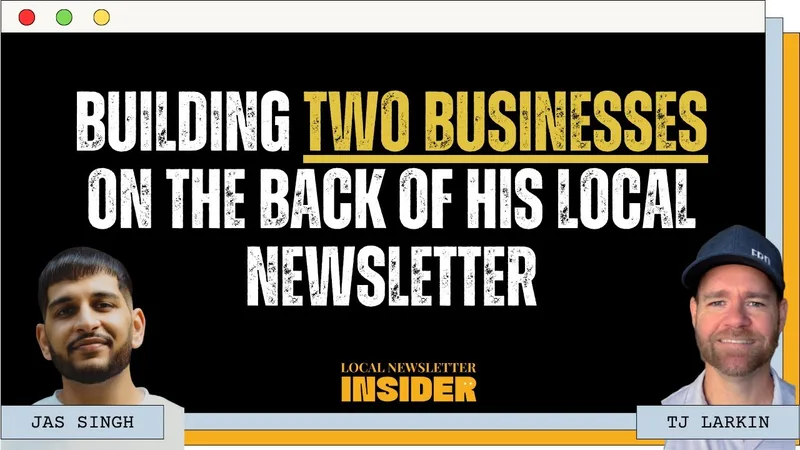
- About a dollar a subscriber at 33,000. Jas spends about $100 Canadian a day on Meta and still adds roughly 100 subscribers a day, at 90 cents to $1.05 each. He keeps the ad format the same and only changes the creative.
- Events were the summer test. He partnered on three local markets and started coffee parties. He handles the marketing and takes a cut. The markets bring in about $20,000 in vendor fees each, before costs.
- Christmas lights is the fall and winter test. It is seasonal, takes a 50% deposit up front, has a clear before and after for ads, and fits an audience of mostly moms.
- Trust comes before short-term money. He would rather lose two or three thousand dollars a month than a reader's trust, because everything else he sells sits on top of it.
Jas Singh runs Winnipeg Digest, a local newsletter in Winnipeg, Manitoba. This is his second time on the show. We first had him on around three months before this recording, and you can hear that one in Landing page optimization cut his acquisition costs in half. Since then he has put on events, kept his Meta costs flat, and decided what he will try next. This time he walks through all three.
A summer of events, with someone else running the logistics
When Jas came on the first time, he was planning farmers-market style events. Since then he has done three, in May, June and July, and has two more booked for August. He did not handle logistics. Jas helped with the marketing, and in exchange he is a partner and gets a cut of the profits.
Entry is free for visitors. Vendors pay about $300 each, and the vendor list is curated, so not everyone who signs up gets in. With about 80 vendors, he thinks that comes to over $20,000 in revenue per market. Out of that come insurance, the mall they pay for the space, bouncy castles, and a character at every one. Batman and a princess showed up last time, and Spider-Man and Snow White before that.
Coffee parties and a Jenga tournament
A coffee party is a morning event, 10 to noon, with a DJ, no alcohol, and coffee, matcha, sparkling drinks, croissants and pastries. Jas says the idea has been popular for about a year in big cities like New York, Toronto, Vancouver and Austin, because people want to socialize without drinking and without staying out until 2 a.m.
The first one had about 50 tickets at $15, each with a free coffee, and it sold out on Instagram in under an hour. The cafe keeps all the food revenue. Jas takes no cut of that.
He noticed the crowd got bored around the 50 to 60 minute mark, so the second one adds a Jenga tournament with four-foot blocks. It has about 70 tickets and a new Korean cafe hosting, which already has its own buzz. Six winners get free pastries and six losers take espresso shots.
Why the creative is the only thing that moves the number
Jas is still adding subscribers for about a dollar each, usually between 90 cents and $1.05 Canadian. He has not changed the type of Facebook ad. He says nine times out of ten the only thing that matters is the creative, and he repeats a line he thinks came from Alex Hormozi: once someone has read your headline, you have spent about 80 cents of your dollar.
So when a format works, he changes the headline, then the subheading, then everything else, one piece at a time. Over the last year he has tested roughly 70 to 80 creatives, about eight to ten a month. Some are video, some are drone shots with the same text, and some are the same ad as a PNG.
He knows the textbook way to do this: one ad set for winners and a separate one for testing, because a winning ad set rarely gives money to something new. He says he has not found the need yet. Instead he switches off the worst performer in the winning ad set when its cost climbs to something like $2.50, and replaces it. If a new creative gets no spend over several tries, he starts a fresh ad set so Facebook will test it.
For ideas he goes to swipefile.com, which he says has about 600 ad creatives from different industries, and borrows what other industries have done. He also watches which of his own Instagram posts do well, because content that performs organically is usually a good ad.
- 011. Keep the ad format the same and change only the creative.
- 022. Swap the headline first, then the subheading, then the image or video, one change at a time.
- 033. Test eight to ten new creatives a month.
- 044. Turn off the worst performer once its cost passes about $2.50.
- 055. Turn the best-performing Instagram posts into ads.
When to boost an Instagram post
TJ asked if Jas pays to boost Instagram posts. Not anymore. He did when he was under 3,000 followers, but now Facebook ads bring in followers anyway. His advice for someone under about 5,000 followers: if a post is clearly doing better than anything you have posted before, boosting it can get you traction toward 10,000 to 15,000. The post has to be good first. "Content is king," he says, and he recommends Cut 30 for anyone starting out with content.
Sponsors got easier, and he knows the ceiling is coming
In the beginning, Jas says, he was fighting for scraps on every sponsorship. Now most brands reply to his messages and sales come in steadily. Using $10,000 a month in revenue as an example, he reinvests around $4,000 of it in ads. He also has about three or four annual advertisers who are getting great results and will stay, which gives him a floor.
At the very bare minimum, I will have a three, four thousand dollar revenue stream, and I can just shut off ads if everything just kind of shuts down tomorrow.
His two best advertisers are an exhibition park and a multifamily housing company. The fair is the biggest and longest-running in the city, and its problem was people finding out about it after it ended. Some of his ads for it passed 1,000 clicks. The housing company has about 20 apartment complexes, and each ad gets 600-plus clicks. The ad changes each month to cover a different property, so it never feels repetitive.
He also says new restaurants and anyone running an event in the city now want to advertise with him. Real estate agents are the exception. He has tried every big realtor in Winnipeg and closed none, so he calls them the hardest group to sell to.
Even so, he knows sponsorship revenue will cap out once every slot is sold. That is why he is looking for other ways to earn from the same audience.
Why he picked Christmas lights
After this summer's events, he has settled on Christmas lights for the fall and winter. It is a real business, not lead generation for someone else. He had already sent leads to lawn mowing and window cleaning companies. The window cleaner made back what it paid in about three hours after the newsletter went out. Now he wants to own one.
His reasons were practical:
- It is seasonal. If it does not work, he can skip next season.
- It needs little capital. He takes a 50% deposit before each job.
- The worst case is mild. He is not handy enough for HVAC, roofing or plumbing, and does not want to botch someone's furnace in winter.
- The before and after is obvious. A house with lights looks better than the same house without them, which makes for good ads.
- It fits the audience. He posted about it on Twitter and a mom in her 40s replied that she would not make the call on HVAC or plumbing, but she would on lights and design.
If the newsletter somehow does not bring in leads, he says he would still run Facebook and Google ads with the same creative testing skills. He plans to hang lights himself at first, the way he wrote his own newsletter three times a week for 40 to 50 weeks, so he can tell good work from bad. He is also not looking forward to working outside at minus 31 Fahrenheit.
Trust comes first, and why no agency
Jas says the guiding idea is to be value first. He does not mind losing two or three thousand dollars a month if it builds trust with the reader. He says the second you lose trust, people open fewer emails and it becomes a domino effect.
He gets messages almost daily. One 80-year-old reader wrote that he has lived in Winnipeg since the 1970s and that this is the greatest resource that has ever come by. Many of his advertisers come from regular readers who suggest a spouse or someone else try an ad. He compares it to Mr. Beast: the audience comes first, and what you sell them should line up with it.
That is also why he skipped an agency. He sees it as a high-churn model where you are always replacing customers, and he cannot promise a plumber a certain number of leads. A home service is black and white: you have heat after he fixes your furnace.
A new business every six months
His advice for anyone starting out is to split the year in two. Spring and summer, test one thing. Fall and winter, test another. This year it was events, and he says another round next summer could mean another $20,000. This winter it is Christmas lights.
Other cities are a maybe. People have asked to use the Digest brand in Calgary and elsewhere, but he feels his edge in Winnipeg is being first to market, and he hates chasing sponsors in a new city. He would only expand if he finds a direct way to make money from the leads. If Christmas lights works, he could start newsletters in other markets that feed that business. He would even give a writer 50% equity to handle writing and sales, while he keeps 100% of the lights.
Questions people ask
Who is Jas Singh?
How much does a subscriber cost him?
How many creatives has he tested?
Why is he starting a Christmas lights business?
TJ is the founder of Local Media HQ. Every week he talks with local media operators about what is actually working in their towns.