
A Power Washing Franchise and a Newsletter at 20 Cents a Subscriber
Ethan Realander left PE fundraising to open a Rolling Suds franchise, then launched Westchester Weekly. Five dollars a day in Facebook ads got him 1,300 subscribers.
 TJ LarkinHost, Local Media HQ PodcastMay 1, 2025 · 9 min read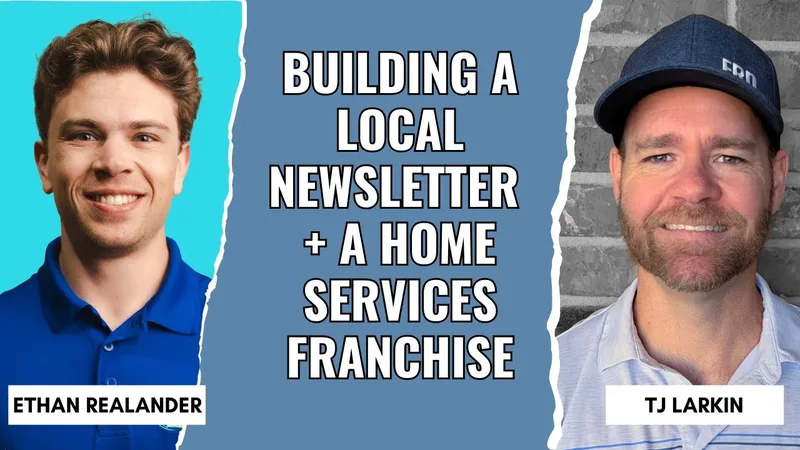
- He wanted to build his own thing, with guardrails. After about six years raising money for PE and VC funds, Ethan bought into Rolling Suds. A franchise gave him branding and a playbook, and left him to build the team and sell.
- Facebook ads got him subscribers for 20 to 25 cents. He started at $3 a day "just for kicks," and at $5 a day he had about 1,300 subscribers and a high-50s open rate by the third edition.
- The newsletter is a free sales channel for the franchise. If readers trust Westchester Weekly, he sees it as an easy, negative-cost way to bring customers to Rolling Suds.
- Two friends make it a team. One writes the draft, one will sell ads, and Ethan wants to share ownership with them if they put in the work.
Ethan Realander runs two young businesses at once: a Rolling Suds power washing franchise north of New York City and a local newsletter called Westchester Weekly. When we recorded, the franchise had launched about two months earlier and the newsletter was on its third edition. He walks through why he chose a franchise, why he started a newsletter on top of it, and the numbers so far. I also gave him advice on his ad, his list and his team.
Why a franchise instead of starting from scratch
Ethan spent about six years in private equity and venture capital fundraising. His firm gave him a shot at the distribution side, selling funds to endowments, pension funds and family offices, when he was 25. Usually you put in five or so years on the project management side first. That sales experience, he says, is valuable in his business today.
He also watched buyout funds buy home services companies, including pest control, HVAC and auto repair. The category looked attractive, but he didn't feel ready to start a brand from nothing. A franchise was "a business with some small training wheels." The branding was handled, and some of the marketing came as a playbook. His job was to build the team and sell.
Why Rolling Suds
Ethan looked at emerging franchise brands. He figured a national power washing and softwashing brand would exist eventually and was surprised there wasn't one yet. Rolling Suds was growing quickly, and the territories near him were still open. They launched on March 1 and were in the middle of busy season when we spoke.
He says Rolling Suds is the largest residential and commercial power washing brand in the country. The work runs from single-family homes to a high school, movie theaters and office buildings. His pitch in an area where people care how their house looks is professionalism, good equipment and a crew that treats the house like its own. He wants to be the name homeowners think of for a cost-effective, high-value service.
Why a newsletter on top of a franchise
Ethan grew up in Fairfield County, Connecticut. His small New England hometown had a local paper, and later a newsletter that started as a couple of moms posting local news on Facebook and then email. He never expected to do something similar. But after reading and listening to local newsletter content, he saw a gap: as far as he knew, Westchester had no high-quality aggregator of events and things to do.
He picked the whole county, about a million people by our rough count, because people there identify with the county as much as their town. It is mostly small towns, he said, with another one 100 yards away. The area is wealthy and has plenty of people with disposable income.
The second reason is the business case. If the newsletter earns a big, trusting readership, he calls it "such an easy negative CAC distribution platform" for Rolling Suds. A free sales channel is a marketer's dream. Ownership matters less to him if that channel works.
We need to not let great get in the way of good and we just need to start.
Subscribers at 20 to 25 cents
Ethan started running Facebook ads about six or seven weeks before we recorded, at $3 a day, mostly for kicks. He quickly saw subscribers coming in at 18 to 21 cents each. That told him there was demand, so he set up the Beehiiv account, the design and the integrations himself, knowing friends would help with the writing and selling.
He was only spending about $5 a day, and the only limit was him raising the budget. He figured doubling it would put him at a few thousand in a couple of weeks. I told him to push it to $20 or $30 a day and that he would regret it if he didn't, but to step up gradually, because jumping too big too fast can hurt.
His own critique was the subject line. Gmail showed "Westchester Weekly" as the sender, and the subject said "This weekend in Westchester." Next week he planned three click-inducing teasers instead. His goal is an open rate above 60%.
The name, and what a bigger send schedule does
I asked whether "Weekly" boxed him in, since we had just gone to two sends a week. Ethan said he hadn't thought hard about it, and that he doesn't want analysis paralysis. If the name gets in the way, the readers can help pick a new one.
I suggested a better move: tell the story to the readers and make a joke of it. We had polled our own list about going to twice a week, and about 75% said yes. A newsletter owner in Canada went from one send to three with few unsubscribes. Ethan's take is that his bigger fear is people not opening, not unsubscribing.
One friend writes, one sells, and equity is open
One friend works in comms and writes the draft each week. The other works in sales and will sell ad slots when the time is right. Nothing is written down yet. Ethan wants to share ownership if they put in lots of work too, because it will be "our thing," and he thinks it would be fun to do with friends.
I added that this works best when none of them depends on the newsletter for their only income. If they treat it as a fun project that builds influence in town, there are many ways it pays off.
The Rolling Suds banner
Ethan's one ad is a banner just below the intro blurb and the featured event. Rolling Suds is not paying for it. It's a clickable logo, a one-liner on local power washing, and a free quote with $100 off if the reader mentions Westchester Weekly. It had zero clicks so far. He wants readers used to seeing ads.
My advice was to make the ad more human and more local:
- 01Say that the owner of the newsletter also owns Rolling Suds, and sell the high-quality service in the copy.
- 02Show the work with a GIF or short video of the crew on a house, since many readers won't know what power washing is.
- 03Name the towns: "in the last month we cleaned houses in these 15 towns."
- 04Run a before and after photo with the town name, and run it monthly so readers see it again and again.
I also suggested running a few free ads to get readers used to them. Ethan tried a version of that: a new pro soccer team had its first home match that Sunday, so he made it the featured event and linked to their ticket page. If it drives traffic, the team becomes a natural advertising partner.
Length, voice and design
Ethan asked how much content is too much. I said we hit Beehiiv's size limit even at two sends a week, mainly because links take up a lot of room. My answer was to fill it until the platform says stop, because readers who stop halfway still count as opens.
On voice, I described what we do: a first-person editorial at the top, often with a photo of us at a restaurant or event, plus an Instagram section. I also try to write what an AI couldn't know, like how a new Chick-fil-A will clog the road in my area. On touchy topics, such as a possible toll road in my town, we report what people are saying without taking a side.
Ethan said the design is fine for now and that he has a running list to improve. His design north star is Michael Coffin's newsletter in the Catskills.
Surveys, replies and a business owner network
Ethan's subscriber survey is working after he rebuilt it, and he had not yet measured how many people click through. The welcome email asks for a favorite restaurant, and he gets at least one or two replies a day. I pointed out replies also help deliverability.
He also asks whether subscribers are business owners. He sees a network of local owners as valuable for him and as likely advertisers, and he's considering a casual meetup to rival BNI-style groups under the Westchester Weekly brand.
Questions people ask
Who is Ethan Realander?
How much does Ethan pay per subscriber?
Why start a newsletter alongside a power washing business?
What was Ethan's biggest next step?
TJ is the founder of Local Media HQ. Every week he talks with local media operators about what is actually working in their towns.